
There is no need to disassemble the tanks, pipes, heat exchangers, fillers and other processing equipment for a thorough cleaning of the interior; that is what clean-in-place (CIP) is for. This automated method is the standard in most food, beverage, dairy and pharmaceutical operations. It has to be, since the state of the equipment’s cleanliness is a matter of product quality and food safety as much as it is of keeping the plant running.
The process involves putting sanitizers, rinse water and cleaning solutions through the equipment at set temperatures, flow rates and contact times. But these are interdependent variables. There is no amount of chemical that will make up for a lack of turbulence, and turning up the heat does not help if the solution is not getting into every part of a tank or pipe.
That is the crux of CIP optimization. Hygienic Manufacturing Solutions has made a name for itself as a leader in this field by looking at the whole cleaning process instead of just putting in more chemicals or longer cycles.
The Most Common CIP Chemicals
A typical system uses alkaline detergents, acid agents and sanitizers, each with its own purpose.
Sodium Hydroxide and Potassium Hydroxide
In the food industry, sodium hydroxide or caustic soda is perhaps the most ubiquitous CIP chemical. A caustic wash is what you use against organic soils like fats, oils, sugars, and proteins; the alkaline agent will saponify, emulsify, and disperse the residue. Potassium hydroxide is much the same and may be the choice for certain applications.
But concentration is key. Under-dosing can leave behind soil and bacteria. Over-dosing is wasteful and puts an unnecessary chemical load on the drain.
Nitric Acid and Phosphoric Acid
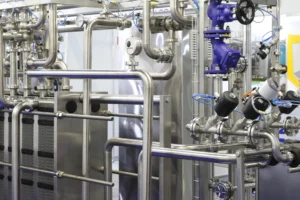 When it comes to inorganic deposits, the job requires an acid cleaner. To get at the milkstone, scale and mineral build-up left by hard water, nitric and phosphoric acids are what are typically used; these can be tenacious on stainless steel and heat exchangers. It is a matter of matching the chemistry to the soil. Instead of simply turning up the strength, one would do well to alternate between an alkaline detergent and an acid product.
Sanitizers
Once the soil is gone, the job of the sanitizer is to get rid of any microorganisms left on the surface. Peracetic acid is popular since it will kill bacteria at low temperatures and degrades without toxic residue. Some operations may opt for chlorine-based products based on their water chemistry or regulations. The effectiveness in this case is a function of pH, hardness, temperature, and concentration.
What a CIP Cycle Looks Like
A normal sequence would be:
- Pre-rinse to clear loose food and residues.
- Caustic wash to deal with fats and proteins.
- An intermediate rinse to flush the alkaline cleaner.
- Acid wash for any mineral deposits.
- Rinse to get the rest of the chemicals out.
- Sanitization to curb microbial contamination.
- Final rinse if the process or sanitizer calls for it.
The equipment has to be able to let the solution do its work and then drain completely. If it does not, you are left with contamination regardless of your chemical program.
Speeding Up Production with Optimization
CIP is seeing a shift from the old fixed recipes to control that is driven by data. With today’s systems, one can be told when the rinse water has returned to baseline, or the cleaning solution is the proper strength; the system will monitor all of it, from cycle time to conductivity. There is good reason for this approach. An additional 15 minutes on a 60-minute run means 15 minutes of lost production, and the method also curbs the use of steam, water, and energy. In the end, the objective is to have the shortest cycle possible that is still validated and leaves the equipment in clean condition.
The Cost of Too Much or Too Little
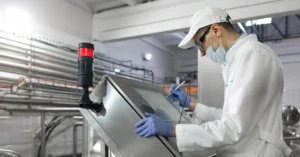
Some may believe that an extra detergent is a safeguard, but it is not. In fact, it only adds to the expense and, depending on local discharge regulations, can result in steeper wastewater treatment bills or surcharges. One could say the plant pays the cost of the surplus twice over: once at purchase and again at the drain.
But there are dangers in being too frugal as well. Fat or protein residues can protect bacteria and put you in the position of having to deal with elevated counts, production losses, or perhaps a recall. The price of such an outcome is nothing like the cost of the chemical.
Different Demands for Food and Pharma
While food CIP is concerned with proteins, sugars, and minerals, the pharmaceutical side has to account for endotoxins and bioburden. There is a need for documented limits and revalidation. In either case, you have to prove the cleaning was effective.
Better chemicals will not fix a flawed design. Even the most refined CIP process is no match for an inept valve sequence, low flow or dead legs. At Hygienic Manufacturing Solutions we have come to understand that you get real optimization only when the entire system is considered; the chemistry must be in step with both the automation and the geometry of the equipment. Do it right and the result is tighter control over contamination, as well as lower costs and less water and energy use.