Hygienic design of food processing equipment sounds like something that should be obvious. If equipment touches food, it absolutely has to be easy to clean, or it’s going to capture residue. Bacteria, allergens, chemicals, and foreign bodies creeping into your products are not acceptable.
A piece of equipment may run beautifully from a production standpoint and still be miserable for sanitation. It may be fast, strong, and expensive, but if the cleaning team cannot reach the food contact surfaces, we have a problem. Food safety does not care how impressive the machine looked when it was new.
Why Hygienic Design Matters
Hygienic design is all about diminishing food contamination risks before they become part of typical operations. Food residue, standing water, sharp corners, cracks, crevices, loose components, hollow areas, and rough equipment surfaces can all cause issues over time.
Occasionally, those issues show up as unsuccessful pre-op inspections. At times, they show up as longer cleaning time. Every now and then, they show up as a product hold, a customer complaint, or a recall that no one wants to talk about.
The objective is not complicated. Food processing equipment should be designed in such a way that it can be scoured to a microbiological level, inspected without a wrestling match, and maintained without creating new risks.
Food Contact Surfaces Come First
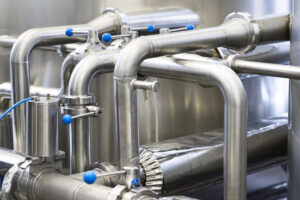
Product contact surfaces deserve the most attention because they touch the food directly. Those surfaces should be impervious, non-porous, non-toxic, corrosion-resistant, and well-matched with the cleaning chemicals used in the facility.
That last portion gets missed sometimes. A material can be suited for the food product and still struggle under the cleaning solution. Harsh cleaning chemicals have to do their job, then be exhaustively rinsed away. The materials must hold up to both the food and the cleaning process.
A smooth surface in the food industry is vital because it helps prevent bacterial adhesion and makes it easier to remove food residues. Stainless steel is preferred in many food processing environments thanks to how it’s naturally durable, corrosion-resistant, and cleanable.
Poorly designed seams do the opposite. They give product residue a place to sit and bacteria a place to grow. We would rather not hand them an invitation.
Crevices, Hollow Areas, and Dead Spaces
The hollow framework in food processing facilities should be extirpated or hermetically sealed so moisture and residue cannot penetrate the system. Equipment shouldn’t have dead spaces where liquid can gather, collect, or gradually increase in quantity or number over time. It is ill-advised to avoid thinking about the flat surfaces since they can harbor still water. Fasteners on food contact surfaces should be minimized because they produce another place for product to amass.
All welds should be continuous and ground flush when needed for a hygienic habitat. Open seams, rough welds, and unfinished joints are not minutiae. They are the kinds of ins and outs that determine whether sanitation is straightforward or has a dismal outlook.
Cleanability and Access
Accessibility goes hand in hand with cleanability. Food processing machinery should be reachable for cleaning, inspection, and maintenance. Removable parts should detach without special tools when it is at all conceivable. Covers, guards, seals, and joints should be designed in such a way that employees can remove, clean, inspect, and reinstall them correctly.
This is where some older equipment designs reveal their decaying stages. They may have been originally designed before modern sanitary design principles were common. The machine still functions, but the design features do not make cleaning easy.
Difficult-to-clean equipment can lead to omitted sanitation steps. It’s not the responsibility of cleaning employees to care about the outcome of the product. They have to keep production happy, and if the cleaning process takes too much time, production gets antsy, leadership starts seeing dollar signs ticking away, and that means that cleaning gets rushed. A spectacular design will make it all possible – sanitation, production, and profit.
CIP, COP, and Sanitation Systems
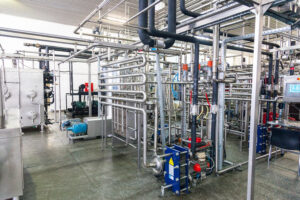
Clean-In-Place systems clean closed equipment without requiring the hassle of disassembly. Tanks, piping, valves, and other processing equipment can be cleaned by circulating cleaning chemicals, water, and heat through the system, meaning that you can meet food safety standards effortlessly.
Clean-Out-of-Place (COP) is different. COP is used when components need to be removed and cleaned manually or in a separate cleaning system. Not all parts can be cleaned without some disassembly unless the equipment is designed that way. Some parts simply need to come off the line for proper cleaning and inspection.
The answer for you depends on the equipment, product residues, sanitation requirements, and intended use. Whatever solution you need to make food handling safe, productive, and cost-effective, HMS can help you achieve it.
Next Steps
HMS helps food manufacturers look at processing equipment the way it will actually get used. Hygienic control can be about making your system look pretty, but that doesn’t help you when the food processor audits come up on the calendar, or consumers are filing complaints about the quality of your product. Hygienic design is combining what you already have with the best, most effective upgrades to make your everyday life easier and your products better.