The data center landscape is undergoing a massive, unprecedented transformation. Hygienic Manufacturing Solutions is proud to be on the forefront of the construction and installation of 3A Sanitary Process Piping required to meet the specs of these new facilities.
As hyperscalers race to build the infrastructure supporting the next generation of artificial intelligence, building contractors are racing to implement engineers’ stringent expectations. This is never more evident than in the industrial-level cooling infrastructure required to support these high-performance computer chips.
With modern AI chips generating immense waste heat (more than traditional data processing chips), traditional air cooling has reached its physical limits. The solution is direct-to-chip liquid cooling, a technology that requires an entirely new approach to data center plumbing.
Amazon Web Services (AWS) is currently the leader when it comes to building these facilities. Their infrastructure buildouts dwarf those of other major players combined. As such, the standards required for building their facilities are rapidly becoming the industry standards.
To manage the thermal loads of their most powerful AI servers, AWS and others are deploying sophisticated liquid cooling architectures, such as the In-Row Heat Exchanger (IRHX) and extensive Secondary Fluid Networks (SFN).
It is a high-stakes environment. A single uncontrolled leak (or microscopic contaminant) can compromise millions of dollars of equipment and cause catastrophic downtime. As such, the standards for piping have evolved from standard commercial plumbing to pharmaceutical-grade sanitary process piping.
This is where HMS steps in. As experts in sanitary process piping creation and installation, we have the track record needed for meeting the standards in this rigorous, ever-changing environment of modern data center cooling.
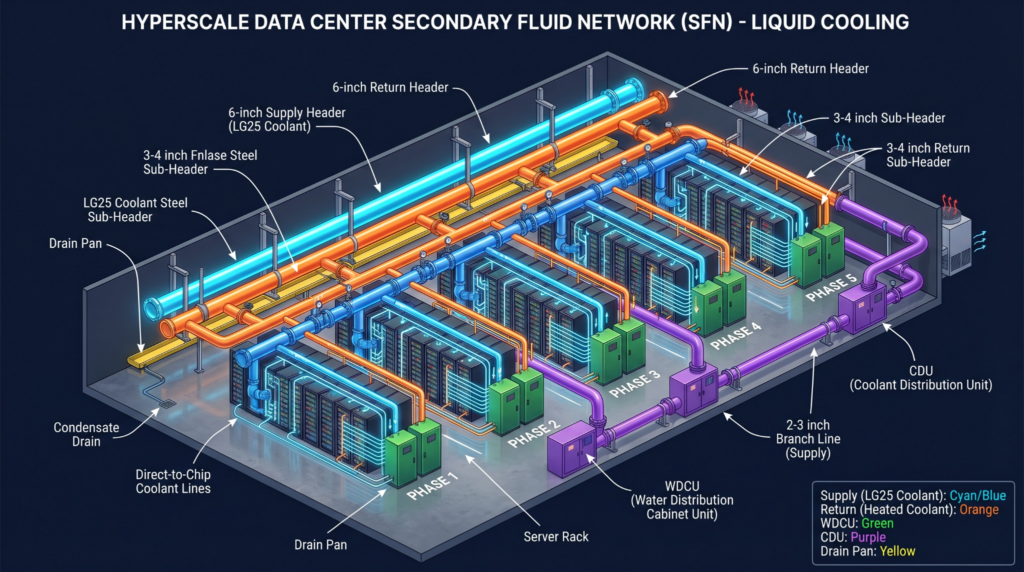
Hyperscalers typically begin with massive, empty warehouse structures, divided into “phases”. A typical building contains 11 phases of liquid cooling infrastructure (though configurations of 6 or 9 phases also exist). Each phase houses rows of servers in painted aluminum racks.
To cool these high-density racks, a specialized coolant — most commonly LG25 (Liquid Glycol 25, a mixture of 75% water and 25% propylene glycol) — circulates through a closed loop, making direct thermal contact with the back of the processors (direct-to-chip cooling, as mentioned above).
This architecture relies heavily on two critical fluid networks:
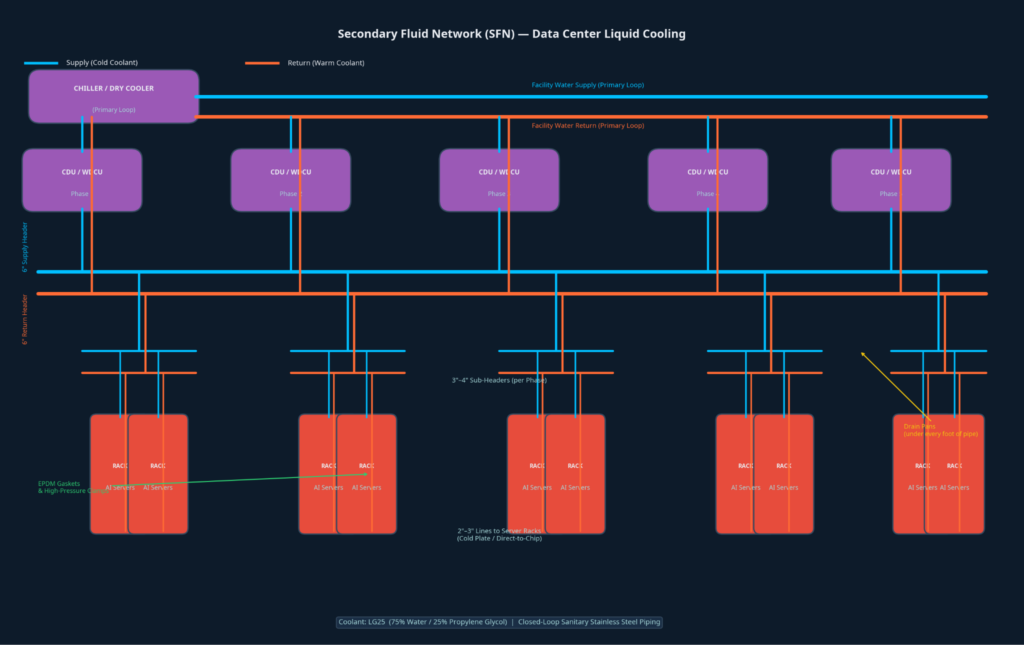
The SFN is the circulatory system that carries the coolant from Coolant Distribution Units (CDUs) to the server racks. The internal rack components are often pre-manufactured by OEM suppliers. However, piping is generally 3A stainless and is made by companies like Hygienic Manufacturing Solutions.
In systems utilizing water-to-water heat exchange, a CFN is also required. This network is prefabricated in our shop. They generally consist of large 6-inch headers, branching into 3- or 4-inch subheaders for each phase, and finally reducing to 2- or 3-inch lines feeding into the Water Coolant Distribution Units (WDCUs).
Because the LG25 coolant flows directly through microchannel cold plates on the chips, the entire fluid path must be immaculate. Corrosion, scale, or particulate matter can clog the microchannels. At best it degrades thermal performance — and with the high heat produced by these CPUs, the risk of destroying hardware is high. As a result, sanitary standards and processes must be strictly enforced.
Hyperscale data centers immediately exposed a significant skills gap in the mechanical contracting industry. Most suppliers lack the specialized expertise required for high-purity, FDA-style systems. At HMS we have spent over a decade living and breathing food and beverage liquid process engineering. Here is how we fulfill the industry’s most stringent requirements:
In hyperscale environments, the tolerance for error is zero. Most facilities strictly enforce a zero on-site welding policy. This eliminates the risk of contamination and fire hazards in the white space.
We use our off-site facility to pre-fabricate these spools. (For the non-engineers reading this, “spools” refer to pre-fabricated, custom-engineered piping assemblies.)
Most contractors lack the expertise to execute this flawlessly. Unfortunately, it is not uncommon to find operators who have never performed full-penetration welds suddenly attempting to use orbital welders for projects requiring over 10,000 welds. These operators not only lack the skill, they lack the quality assurance demanded to ensure a high quality finished project.
Our state-of-the-art fabrication shops allow us to design, build, and test custom spools and component fabrication for SFNs and CFNs. By prefabricating these spools in a controlled environment, we guarantee the structural integrity and cleanliness of the system before it ever reaches the data center floor.
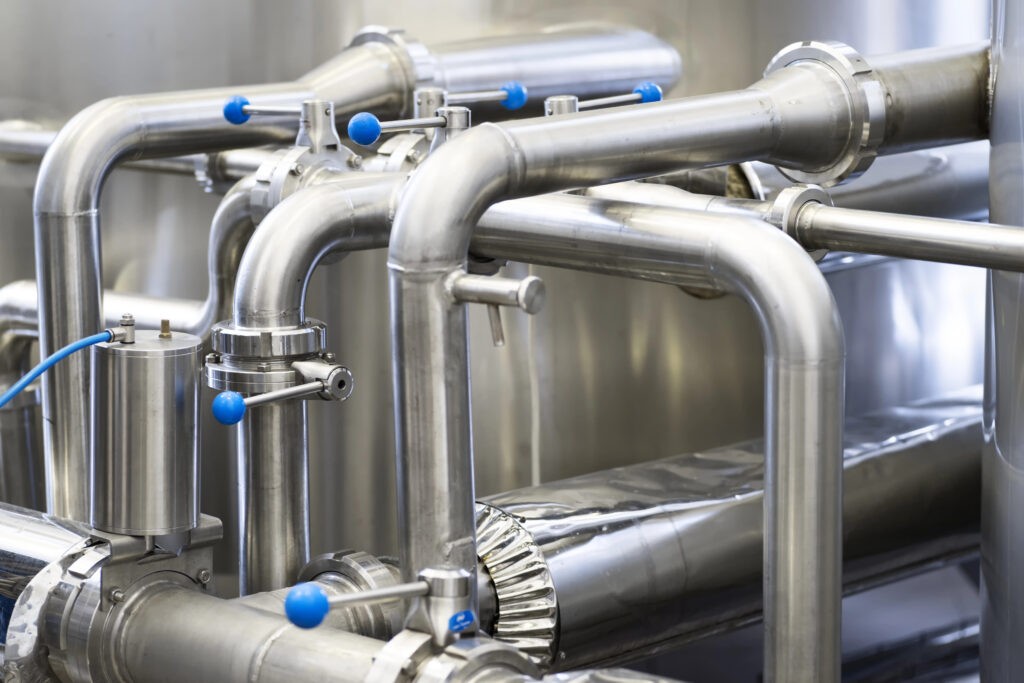
Early iterations of liquid cooling networks faced significant challenges with connections. Early designs relied on Polytetrafluoroethylene (PTFE, AKA Teflon) gaskets for the piping, and standard wingnut tri-clamps. These proved inadequate under pressure. Essentially, those choices turned the cooling network into an unintended sprinkler system.
Operators were installing overhead drain pans beneath every foot of pipe, a costly, ongoing operational cost.
We now use high-pressure clamps and EPDM (Ethylene Propylene Diene Monomer) gaskets. EPDM provides a superior, hygienic seal that can withstand the daily operational pressures of the cooling loop, though many facilities still require the legacy drain-pan solution for all piping.
The most challenging aspect of modern data center piping is the passivation process. To prevent corrosion, the stainless steel piping must undergo chemical passivation to restore its protective chromium oxide layer. Industry standards, largely defined by manufacturers, mandate a costly and highly strict passivation protocol. This is done in two stages: Procedure 1 is the shop pre-commissioning, and Procedure 2 is the on-site commissioning.
Before shipping, spools undergo a pre-rinse using distilled water or the LG25 glycol mix. The system is filtered, drained, and then subjected to a chemical passivation step. Maintaining the exact flow rate per pipe diameter is strictly enforced and must be validated, often taking upwards of 10 hours.
The exact process is repeated on-site after installation, confirming that the installed system still meets the same validated cleanliness and flow standards under real plant conditions.
The cost is important to factor into the process. Contractors must either subcontract this work at a premium or build out their own validated processes. We have the expertise to navigate these complex passivation requirements — ensuring that every spool meets the stringent cleanliness standards required for LG25 coolant loops, protecting the hyperscaler’s investment from day one.
The specifications for data center liquid cooling are not static; evolutions in the industry are super-rapid and extreme. As chip densities increase, the demands on the SFN and CFN will only become more rigorous. Reach out to speak with one of our engineers about your specific project and unique demands.
Explain your Engineering Challenges and We’ll have a Team Member Connect!
HACCP, SQF & regulatory-aligned from day one.
We modernize old factories or design from scratch.
Nationwide sanitary welding & commissioning support.